




The editorial team has strong opinions about what it does and doesn’t like, and that applies to Abu Dhabi’s architecture among (many) other things. Following on from our previous list, here are five more Abu Dhabi buildings we love.
Capital Gate Building
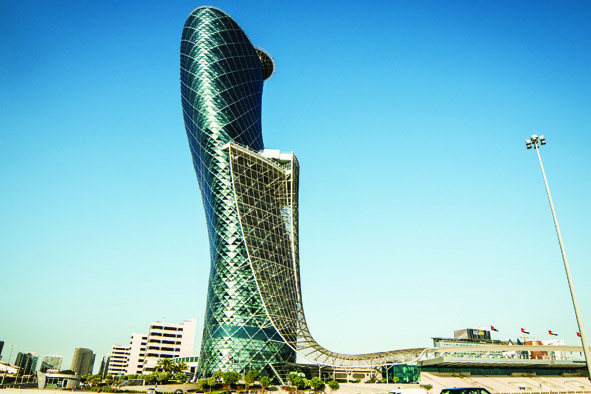
The ‘World’s Furthest Leaning Manmade Tower’ (certified by Guinness World Records) leans 18 degrees westwards, and that makes it one of the most spectacular buildings in town – especially as it has no immediate competition, so its dramatic elegance can be appreciated from all directions. The tower’s floors are stacked vertically up to the 12th storey but thereafter are staggered over each other by up to 1,400mm all the way up to the 35th floor, 160m above ground level.
The other clever bits include the use of a super-strong exoskeleton called the diagrid that takes all the weight of the floors and removes the need for internal pillars or beams. The distinctive stainless steel ‘splash’ that descends from the 19th floor and stretches over Adnec is designed to eliminate over 30 percent of the sun’s heat before it reaches the Capital Gate building.
The architects are RMJM, a giant practice whose portfolio includes some other Abu Dhabi candidates such as the Sheikh Zayed Air Navigation Centre next to Etihad HQ, the rest of Adnec and the Aloft hotel, bits of Marina Square on Reem, and master planning for the Raha Beach development.
Sheikh Zayed Bin Sultan Al Nahyan Mosque
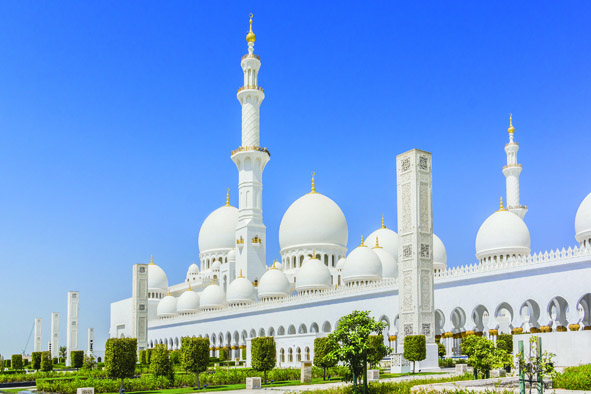
It was planned by HH Sheikh Zayed bin Sultan al Nahyan, though construction didn’t start until after his death. It took 11 years to build and opened in 2007 – and it’s clear that both the wait and the effort were worth it. It’s the largest mosque in the UAE by some distance and the third largest in the world, covering more than 30 acres of building quite apart from the extensive (and still incomplete) exterior landscaping and car parks.
It’s an important religious landmark, but it’s also a major symbol of national pride. It has been described as one of the most important architectural treasures of contemporary UAE society, which is surely unarguable.
And whatever your religious or national inclinations, it’s also beautiful. The scale and the elegance of the design are matched by the attention to detail – just look at the gilded decoration on the pillars in the main courtyard, and check out the unique lighting system (designed by top lighting architects Speirs + Major) which projects on to the domes with greater or lesser brightness to reflect the phases of the moon.
Abu Dhabi Central Bus Station
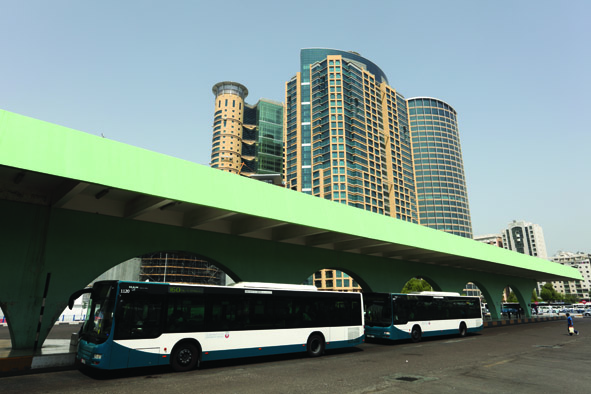
You either love or hate this triumph of reinforced concrete, a classic of 1980s Abu Dhabi Modernism. It’s big – four stretched arms sweep outwards from the main building to provide shade for passengers boarding the buses – but at the same time manages to be quite human in scale, and environmentally is all about “passive” design (which in this case means shade rather than a/c).
It’s a vivid minty green which polarises opinion; but it just needs a bit of sprucing up and perhaps some of the clever landscaping that’s been done elsewhere in Abu Dhabi, and this bit of prime real estate next to Al Wahda Mall could take its rightful place in the centre of city life. TCA Abu Dhabi says it intends to protect the structure, naming it among “the key threatened monuments now in Abu Dhabi”; on the other hand, the Dept of Transport wants to modernise the whole public transport infrastructure. Let’s hope they can find some common ground.
In the meantime, “its expansive futuristic interiors will fit well for a sci-fi film or period Middle Eastern dramas” says the Abu Dhabi Film Commission’s locations guide; and who could disagree with that?
Masjid Al-Aziz
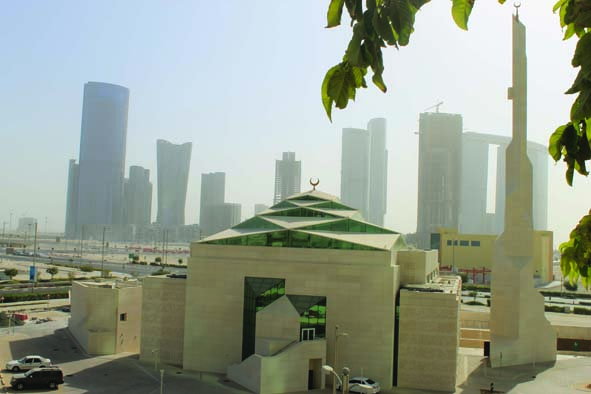
The Grand Mosque gets all the attention, and of course it deserves the acclaim; but here’s a gem on a smaller scale. Al Reem Island finally acquired a mosque when this building was formally inaugurated at the start of Ramadan. It has three prayer rooms – one large, one smaller, one for women – and can accommodate up to 2,500 worshippers.
It’s a stylish modern design, fitting in well with the internationalist look and clean lines of the Marina Square development of which it is a part. Unlike the neighbouring residential towers, though, Al Aziz mosque uses slopes and angles that catch the light; the minaret in particular is almost a cubist tower of patterned planes, with variations of light and shade that suggest different colours.
And in the evening something almost magical happens: the exterior glows with calligraphy, the 99 names of God appearing as LEDs light them up from inside – though in fact it’s just a clever reflection of external lighting.
The designer was APG, a practice that was founded in Egypt in the late sixties but has been active in the UAE since 1973 – including much of the Marina Square development alongside this mosque.
Al Bahr Towers
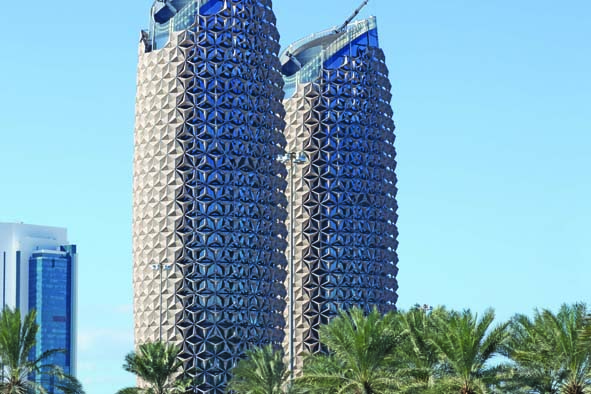
You know the buildings at the junction of Al Saada Street and the Eastern ring road: pineapples, corn on the cob, loofahs. Aedas, the architects who got the job, were briefed to provide a pair of outstanding landmark buildings of the highest architectural quality reflecting the standing and prominence of the Abu Dhabi Investment Council, the owner and principal tenant (Al Hilal Bank has the other tower).
It’s the clever sunshine-sensitive update of the traditional mashrabiya lattice screen that takes the eye, automatically opening and closing in response to the sun’s path. That cuts the solar heat that has to be dispersed by air conditioning – environmental sensitivity was a key feature of the brief, and the dynamic screen means a reduction in heat gain of at least 25 percent – but it’s not the only technically advanced aspect of the buildings.
“Our concept,” says Aedas’ joint MD Peter Oborn, “was generated from a mathematically pre-rationalised form which was in turn derived from Islamic principles.” Among other things, that is realised in a crystalline, honeycombed internal structure that is stable, flexible and economical.
It looks good, it works well, and it’s helping to save the planet. A bit.
Editor’s note: In the originally published version of this article we incorrectly stated in relation to Masjid Al-Aziz that “the exterior glows with calligraphy, the 99 names of the Prophet (PBUH) appearing as LEDs Light them up from the inside.” This should have read the 99 names of God. We deeply regret the error and apologise for any inconvenience caused.